
Tysons Office Market 2026: What Tenants Need to Know Before Leasing Office Space
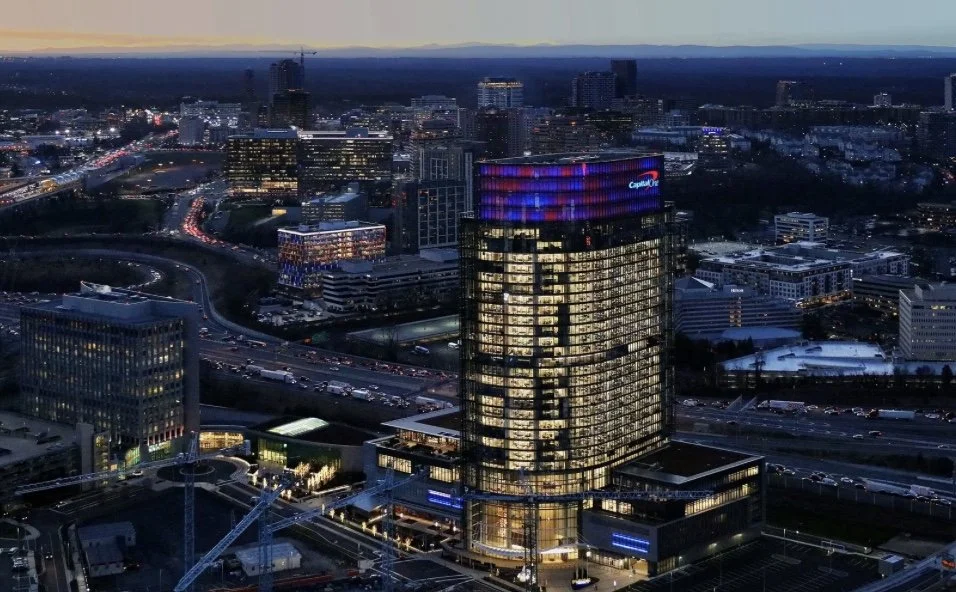
There has never been a better time to be an office tenant in Tysons Corner.
There has also never been a more confusing time.
Two things can be true at once, and that is the whole problem. Tysons is sitting on roughly 31 million square feet of office space across 261 buildings, and as of September 2026 about 7 million of those square feet are available. That is a genuinely enormous amount of choice. You could tour space for a year and not see all of it.
But choice is only valuable if you can compare things. And Tysons right now is one of the least comparable office markets in Northern Virginia. Two buildings on the same street, built in the same decade, with the same drive time to the same Metro station, will quote you rents that are more than twenty dollars apart. One of them might be a bargain. The other might be a trap. The asking rate will not tell you which is which.
If you have a lease coming up in Tysons, here is what the market actually looks like underneath the headline numbers, and what you should be evaluating before you sign anything.
First, the market is not crashing and it is not recovering. It is sitting still.
Everyone has an opinion about office. Most of those opinions are about a year and a half out of date.
Here is what the data actually shows. Tysons office vacancy at the end of 2023 was 18.3 percent. It peaked at 19.6 percent in the third quarter of 2024. As of this writing it sits at 18.4 percent.
Twelve straight quarters. The needle has moved about a point and a half, in both directions, and landed almost exactly where it started.
That is not a market in freefall, which is what a lot of tenants still believe. It is also not a market in recovery, which is what a lot of landlords would like you to believe. It is a market that has found a level and parked there.
Why that matters to you: a stalled market is a negotiable market. Nobody is panicking, so nobody is giving space away. But nobody is getting bailed out either, so the landlord with real vacancy has no particular reason to think next year fixes anything. Twelve quarters of evidence says it will not. That is leverage, and it is the kind of leverage that lasts long enough to actually use, provided somebody on your side of the table knows how to use it.
The average asking rent is real, and it is also basically useless
The average asking rate across Tysons office space is $40.21 per square foot, full service.
Now here is the number nobody publishes. The median full service quote in the same market is about $32.
When the average sits eight dollars above the middle of the pack, it is telling you the average is being dragged. And it is. The top of the Tysons market quotes $71 and $72 a foot. The bottom quotes $20. That is not a range, that is two different markets wearing the same zip code.
So when someone tells you "Tysons runs about $40," they are technically right and practically useless. Half the market is nowhere near $40. If you walk into a negotiation anchored on the average, you are either overpaying badly or shopping in a tier you cannot afford, and you will not know which until you have wasted four months.
The spread on individual streets is the part that should really get your attention:
Jones Branch Drive: quotes run from $23.43 to $47.90. Same street. More than double.
Leesburg Pike: $23.97 to $43.00.
Greensboro Drive, where ten buildings publish rates: $35.00 to $50.00.
Boone Boulevard: $25.00 to $31.80.
You can stand in one spot and see buildings that are twenty dollars a foot apart. Sometimes there is a very good reason. Sometimes the reason is that one owner adjusted to reality four years ago and the other one has not yet.
The quoted rate is not even the same unit of measurement
This is the part that catches sophisticated people, and it catches them because it is genuinely sneaky.
Not every landlord in Tysons is quoting you the same thing. Across the buildings publishing a rate right now, the quoting conventions include full service, modified gross, triple net, full service plus utilities, full service plus cleaning, full service plus electric and cleaning, and one building simply listed as negotiable.
There is a building in Tysons quoting $12 triple net. There is another quoting $72 full service. Those numbers are six times apart and they are not measuring the same thing at all. Depending on the building, operating expenses and taxes can add ten to fifteen dollars a foot on top of a net quote, and a "plus utilities" or "plus cleaning" structure quietly shifts costs onto you that you assumed were baked in.
A tenant comparing a $28 modified gross quote against a $31 full service quote may well be looking at the more expensive building when they pick the cheaper number. That is not a hypothetical. That is Tuesday.
Rule of thumb: never compare asking rents. Compare total annual occupancy cost, all in, over the full term. Everything else is decoration.
About a third of the market will not even tell you the price
Here is a detail that says more about this market than any vacancy statistic.
Of the 261 buildings in the Tysons inventory, only 108 publish an asking rate at all. And among buildings that currently have vacancy, seventeen of them are sitting on a combined 785,000 square feet of empty space with no published number whatsoever.
Sometimes "call for pricing" means the space is trophy quality and the owner wants a conversation. More often it means the owner has not decided what the space is worth, or has decided and does not want it in writing where the tenant in the suite below can see it.
Either way, the practical translation is the same. In a market this fragmented, the published numbers are an incomplete map, and the buildings that stay off the map are frequently the ones with the most room to move. You do not find those by browsing listings. You find them by being in the market every week and asking.
Where the vacancy actually lives, and why it is not spread evenly
Eighteen percent vacancy sounds like a building in Tysons is, on average, about a fifth empty.
That is not remotely what is happening.
Eighty six buildings in Tysons, holding nearly 11 million square feet, are one hundred percent leased. Zero vacancy. Meanwhile fifteen buildings are more than half empty, and those fifteen buildings alone hold about 28 percent of all the vacant space in the submarket.
The extremes are genuinely striking. There is a 200,000 square foot building on Towers Crescent Drive that is entirely vacant. There is a 404,000 square foot tower on Tysons Central Street sitting at 98.6 percent vacancy while quoting $65 a foot, which is either extraordinary conviction or an extraordinary opportunity depending on who is doing the asking. Seven buildings in Tysons can currently deliver a contiguous block of 100,000 square feet or more.
So the market is not uniformly soft. It is bifurcated, hard. A portion of Tysons is effectively full, a portion is comfortably occupied, and a concentrated slice is very, very empty.
Two things follow from that. First, if your requirement fits into one of the distressed buildings, your leverage is dramatically better than the market average suggests. Second, if you have your heart set on one of the full buildings, the market average is going to do you no good at all and you should stop quoting it in negotiations.
One more piece worth knowing: total availability in Tysons, 7 million square feet, runs about 1.3 million square feet higher than total vacancy. That gap is space that is currently leased and occupied but already being marketed, including roughly 542,000 square feet of sublease space. Some of the best value in this market is in that gap, because a sublandlord paying rent on space they do not use has a very different motivation than an owner with an empty floor and a long time horizon.
What you should actually be evaluating
Once you accept that the asking rate tells you close to nothing, the question becomes what does. Here is the list we work through with every tenant representation client, roughly in order of how much money it moves.
Effective rent, not face rent. Take the total rent over the full term, subtract every month of free rent, subtract the improvement allowance, add any costs the quote structure pushes onto you, and divide by the term. That is the number. A $38 quote with ten months free and $75 a foot in improvement dollars will beat a $32 quote with nothing attached, and it is not close. Landlords protect face rate because it protects building value and future comps. Most of them will pay you handsomely, in concessions, to let them keep it. Let them.
The tenant improvement allowance, and who actually controls the work. In a market with this much standing vacancy, TI is where the real negotiation lives. Understand whether the allowance is genuinely sufficient for your build, who manages construction, what happens to unused dollars, and whether the landlord has the capital to actually fund it. That last one is not a rhetorical question in 2026. A generous allowance from an owner who cannot fund it is worth nothing.
Building quality, honestly assessed. Not the lobby. The systems. HVAC age and capacity, elevator performance, restroom and common area condition, backup power, the state of the roof and the parking structure. You will live with these for a decade. A newly renovated lobby on a building with thirty year old mechanical systems is a very expensive-looking distraction.
Metro proximity, measured in walking minutes and weather. Tysons has four Silver Line stations and the market treats proximity to them as a premium, which it is. But measure it honestly. A building marketed as "steps from Metro" that requires crossing Route 7 in February is not the same asset as one with a covered walk. If your team's commute drives your retention, this line item is a hiring cost, not a real estate cost.
Amenities you will actually use. Fitness centers, conference facilities, food service, and tenant lounges are real value when they are real. Ask what hours they operate, whether they are included or separately charged, and what happens if building occupancy drops further. Amenity packages get quietly cut in half-empty buildings.
Parking, in writing. Ratio, reserved versus unreserved, monthly cost per space, whether the cost is fixed or escalates, and whether spaces are guaranteed for the full term. In Tysons, parking economics can swing your all-in occupancy cost by several dollars a foot. It is routinely the least negotiated and most expensive item in the deal.
Term, and the options attached to it. Longer terms buy better concessions, and in this market they buy a lot of them. But they also lock you into a footprint you may outgrow or shrink out of. Expansion rights, contraction rights, termination options, renewal options with a defined rate mechanism. These cost very little to negotiate now and are nearly impossible to buy later.
Operating expense structure and the base year. Understand the expense stop or base year, what is included in the expense pool, whether there are caps on controllable expenses, and your audit rights. In a building with rising vacancy, your pro rata share of a shrinking expense base can behave in ways you did not plan for.
The landlord itself. Who owns the building, what is the debt situation, are they investing in the asset or harvesting it. An owner heading toward a loan maturity behaves very differently from a stabilized long term holder, both in what they will give you at signing and in how they treat the building afterward.
Why this market rewards representation more than a normal one
In a tight, uniform market, a tenant broker mostly saves you time.
In a market like this one, with 22 percent availability, a twenty dollar spread on a single street, a third of the inventory refusing to publish a price, and vacancy concentrated in a handful of very motivated buildings, tenant representation is the difference between a good deal and a deal you will regret for a decade. The information is not evenly distributed. It is not even evenly published.
At Axios Property Group, we work this market the old fashioned way, because that is what surfaces the deals that are not in a database. We drive the buildings. We call the owners. We keep lists of who is quietly losing a tenant, whose loan is maturing, who just lost a floor and needs a signature before year end. We know which "call for pricing" buildings will actually move and which ones are posturing.
And here is the part that genuinely changes how we advise you. Axios does not only represent tenants. We own and lease our own commercial space, and we manage buildings for other owners. We sit on the landlord side of real negotiations, with our own capital at risk.
That means when a landlord tells you a concession is impossible, we usually know whether that is true. We know what a free rent package actually costs an owner versus what a rate reduction costs them, and which one they will trade. We know how a leasing agent's incentives are structured. We know what the building's rent roll probably looks like and what that does to their flexibility. You cannot learn that from a listing. You learn it from being on the other side of the table for years.
The bottom line
Tysons Corner in 2026 is a tenant's market that does not look like one from the outside.
The headline vacancy has barely moved in three years, which reads as stability but actually means twelve quarters of landlords learning that waiting does not work. The average rent is a statistic, not a price. Buildings a hundred yards apart are priced worlds apart, quoted on different bases, and a third of them will not quote at all. And the vacancy that exists is piled into a handful of buildings whose owners have run out of patience.
None of that shows up in a listing search. All of it shows up in your effective rent if someone actually works it.
The tenants who do well here are not the ones who find the cheapest asking rate. They are the ones who start early, evaluate the whole deal instead of the headline, and understand which buildings have a reason to say yes.
That is the part somebody should probably be paying attention to, ideally more than nine months before your lease expires.
Before you sign anything
If you have an office lease coming up in Tysons Corner, or you are looking at space now and cannot tell whether the number in front of you is good, have a conversation early.
We are happy to tell you honestly what your requirement should cost in this market, which buildings are realistically going to compete for you, and what concessions are actually available rather than what is being advertised. Whether you need 2,000 square feet or 200,000, across Tysons Corner, McLean, Vienna, and the greater Northern Virginia region, the work is the same: get you the right building on terms that hold up for the whole term.
No pressure, no obligation, and no charge to talk it through. Worst case, you get a straight second opinion on a deal you were going to do anyway. Best case, we save you several dollars a foot for the next ten years.
Reach out to Jason Drakopoulos or visit Axios Property Group before you sign.
Axios Property Group provides commercial real estate services including tenant representation, office leasing, property management, landlord representation, retail and industrial leasing, brokerage, and advisory work for retail, office, industrial, and mixed-use properties throughout Tysons Corner, McLean, Vienna, Fairfax County, Loudoun County, Prince William County, Leesburg, Fairfax, and the greater Northern Virginia region.
For more information about tenant representation, office leasing in Tysons Corner, or any of our commercial real estate services, visit Axios Property Group.
About the Author
Jason Drakopoulos is President of Axios Property Group, a Northern Virginia commercial real estate firm specializing in commercial property management, landlord representation, tenant representation, leasing, brokerage, and asset management throughout Fairfax County, Loudoun County, Prince William County, Tysons Corner, Leesburg, Fairfax, and the greater Northern Virginia region.
⸻
Market data in this article is drawn from CoStar Group and reflects the Tysons Corner office submarket as of September 2026. Market conditions change. The frameworks do not.
