
Sell, Lease, or Hold? How Northern Virginia Commercial Property Owners Should Decide
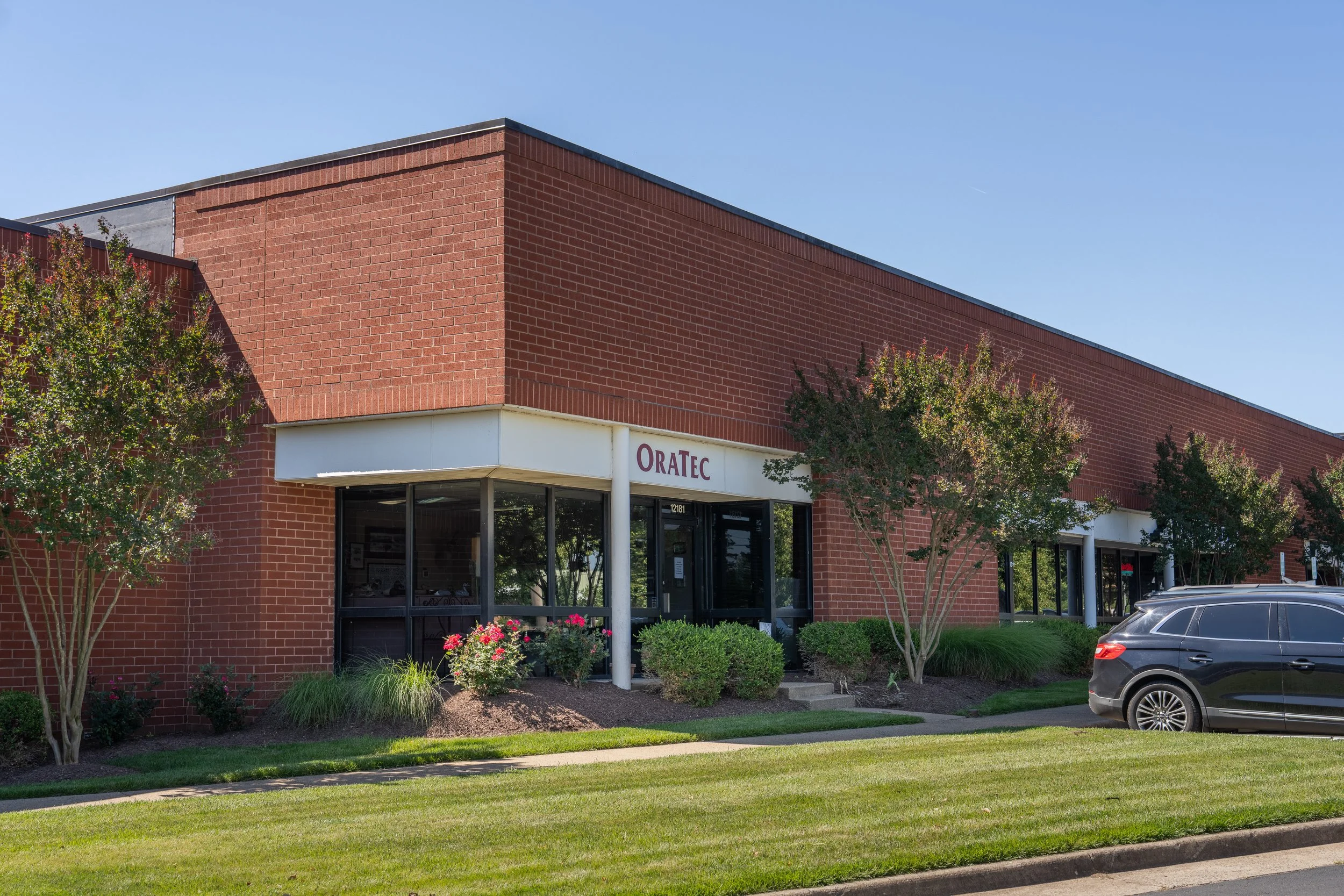
Every commercial property owner eventually gets to the same fork in the road.
A tenant gives notice. A loan comes due. A partner wants out. Or you simply look at the building one morning and wonder whether it is still the best place for your money.
Sell it. Lease it. Or hold it.
Most owners frame this as a question about price. What is the building worth? That is the wrong first question.
The right first question is this: what is the best use of this equity from here forward?
Price is one input. So are taxes, debt, the buyer pool, the cost of vacancy, and what you want the next ten years of your life to look like. Get the framework right and the answer usually becomes obvious. Get it wrong and you can leave hundreds of thousands of dollars on the table without ever knowing it.
Here is how we walk owners through it.
The three paths, side by side
Before the math, be clear about what each path actually means.
| Sell | Lease Up | Hold | |
|---|---|---|---|
| What it means | Convert the building to cash, or exchange into another property | Fill the vacancy first, then hold or sell as a stabilized asset | Keep the building as it is, with its current tenant or as an owner-user |
| What you get | Certainty, liquidity, a clean exit | A higher value if leasing adds more than it costs | Ongoing income and deferred taxes |
| What you give up | Future appreciation and income | Time, capital, and some risk | Liquidity and, often, a better return elsewhere |
| Best when | Buyers are paying a premium, or your equity is underperforming | Vacancy is the main thing holding value down | Income is stable and a sale would be expensive |
There is no permanently right answer. There is only the right answer for this building, this owner, at this moment.
Question 1: What is your equity actually earning?
This is the question owners skip most often, and it is the one that matters most.
Owners who have held a building for a long time tend to measure their return against what they paid. That number looks wonderful. It is also irrelevant.
Here is an example.
An owner bought a flex building in Fairfax County for $1,400,000. The loan is paid off. The building is now worth about $3,500,000, and it throws off $175,000 a year in net operating income.
| On what you paid | On what it is worth today | |
|---|---|---|
| Value | $1,400,000 | $3,500,000 |
| Net operating income | $175,000 | $175,000 |
| Return | 12.5% | 5.0% |
The owner feels like they are earning 12.5 percent. They are not. They are earning 5 percent on $3.5 million of equity, because that is what they could walk away with tomorrow.
That does not automatically mean sell. A 5 percent return on a well-located, well-leased, low-maintenance building may be exactly what this owner wants. But it should be a decision, not a default.
Takeaway: Measure your return against what the building is worth today, not what you paid for it. Your equity is the money you could have in hand tomorrow. Ask what else it could be doing.
Question 2: What does vacancy cost while you decide?
If the building is empty, or about to be, the clock is already running.
We like to say a vacant space eats four meals a day: real estate tax, CAM, insurance, and utilities. Those bills keep coming whether or not anyone is paying rent.
Take a 12,000 square foot small-bay flex building that just went vacant.
| Monthly carrying cost | Amount |
|---|---|
| Real estate tax | $3,200 |
| CAM and maintenance | $2,400 |
| Insurance | $900 |
| Utilities | $1,000 |
| Out of pocket each month | $7,500 |
| Rent you are not collecting ($17/SF NNN) | $17,000 |
| Total cost of sitting empty, per month | $24,500 |
That is $90,000 a year out of pocket. Add the rent you are not collecting and a year of indecision costs this owner close to $300,000.
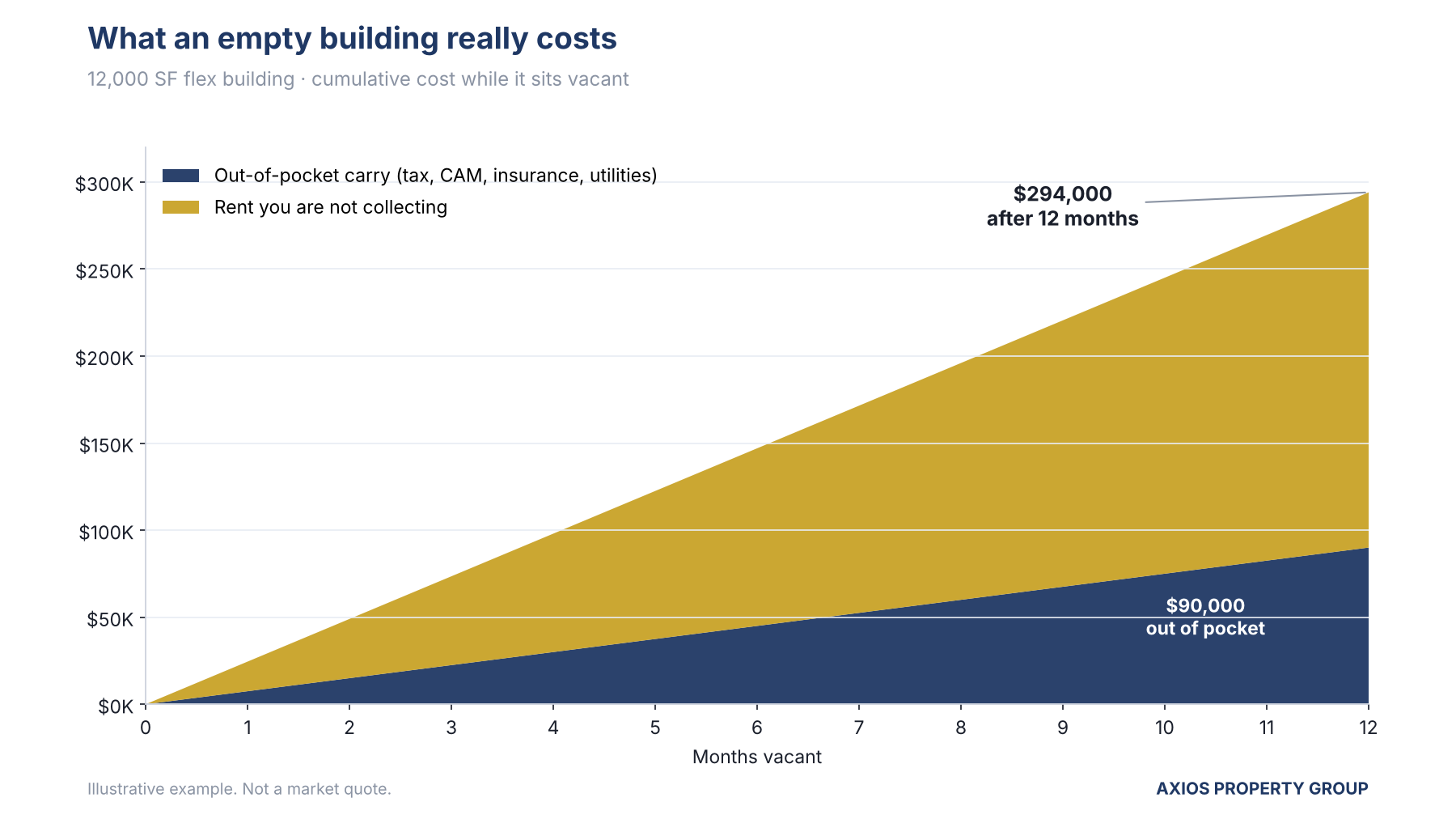
The point is not that vacancy is a crisis. Every owner deals with it. The point is that waiting is not free. "Let's see what the market does" is a decision, and it has a price tag.
Takeaway: Waiting is a strategy only if you have priced it. Do the math on your monthly carry before you decide to wait.
Question 3: Who is the buyer, and what will they pay?
This is where Northern Virginia gets interesting, and where most owners guess wrong.
There are two very different buyers for commercial property:
- Owner-users buy a building to occupy it. They value it the way a business values a long-term home: control, stability, and an end to paying rent. They often pay more for a vacant building than an investor would pay for a leased one.
- Investors buy income. They value a building based on the rent it produces and how secure that rent is. To an investor, vacancy is risk, and risk gets priced in heavily.
Which buyer your building attracts can flip the answer completely. Here are two real-world style examples. Same question. Opposite answers.
Building 1: A vacant 12,000 SF small-bay flex building
Small-bay flex is a product owner-users love: contractors, service companies, specialty trades, light assembly. Owner-users compete for it.
| Sell Vacant Now | Lease Up, Then Value | |
|---|---|---|
| Sale price / stabilized value | $3,300,000 (to an owner-user at $275/SF) | $3,020,000 ($204,000 NOI, valued by an investor) |
| Downtime carry (8 months) | — | ($60,000) |
| Free rent (4 months) | — | ($68,000) |
| Tenant improvements ($12/SF) | — | ($144,000) |
| Leasing commissions | — | ($117,000) |
| Net value to the owner | $3,300,000 | $2,631,000 |
Selling wins by roughly $669,000. And that is before you count the time, the risk that the lease-up takes longer than planned, and the risk that the tenant you sign is not the tenant an investor wants to buy.
Building 2: A 10,000 SF retail center that is half vacant
Now flip it. A neighborhood retail center has 5,000 square feet leased and 5,000 square feet empty. There is no owner-user for a multi-tenant strip center. The only buyers are investors, and they will price the vacancy as risk.
| Sell As-Is Now | Lease Up, Then Value | |
|---|---|---|
| Net operating income | $140,000 (half leased) | $280,000 (fully leased) |
| How an investor prices it | A heavy discount for vacancy risk | A stabilized, fully leased center |
| Sale price / stabilized value | $1,750,000 | $4,000,000 |
| Tenant improvements ($30/SF) | — | ($150,000) |
| Free rent (3 months) | — | ($35,000) |
| Leasing commissions | — | ($96,000) |
| Downtime carry (9 months) | — | ($45,000) |
| Net value to the owner | $1,750,000 | $3,674,000 |
Here, leasing first wins by roughly $1.9 million. Selling a half-empty center is handing the buyer the profit from filling it.
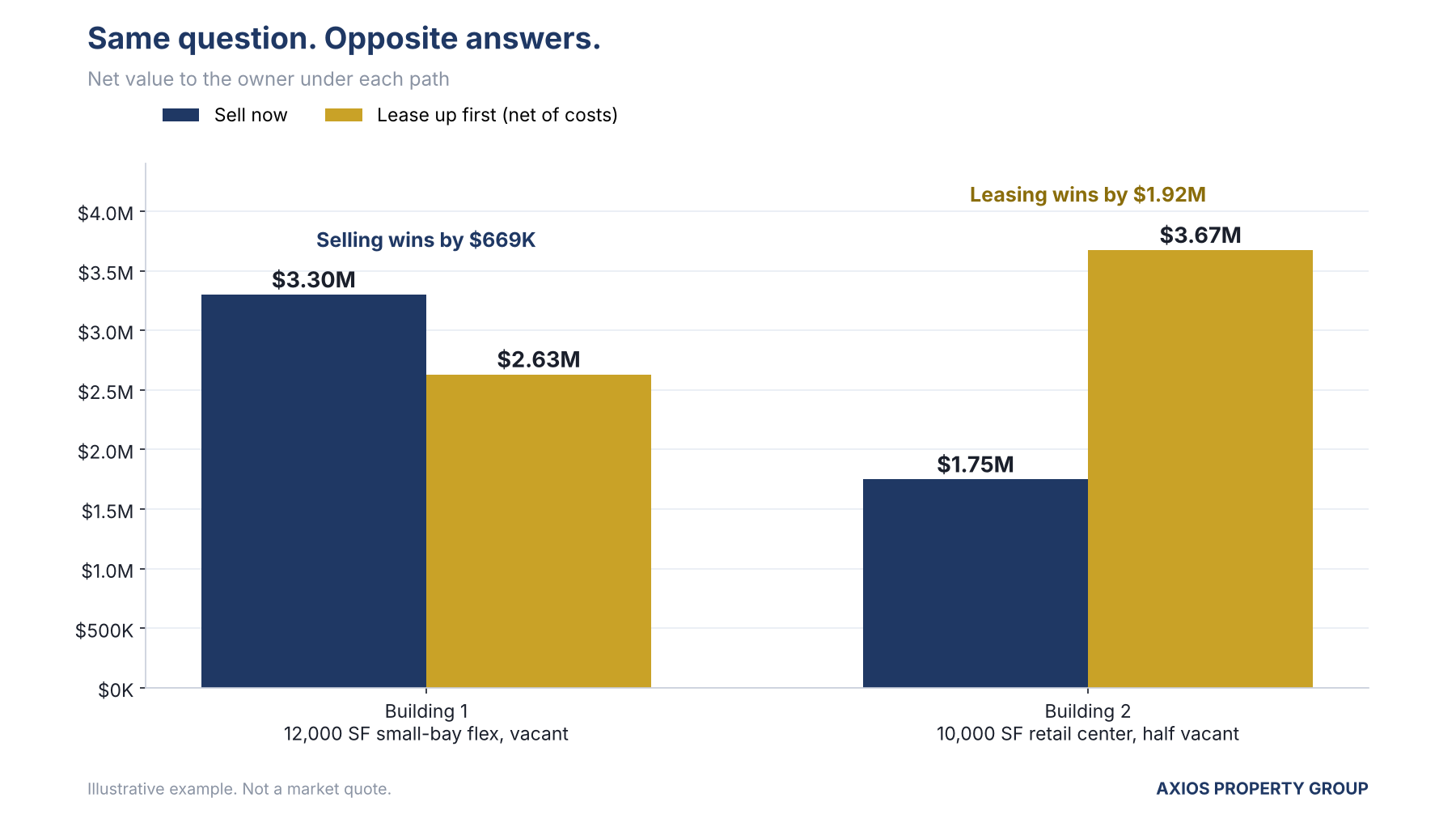
The figures in both examples are illustrative. They are built to show how the decision works, not to quote today's market. Your building's actual numbers will differ, sometimes by a lot.
Takeaway: The buyer pool decides the strategy. If owner-users will pay a premium, a vacant building can be worth more than a leased one. If only investors will buy, vacancy is the most expensive thing you can sell.
Question 4: What will the tax bill be?
This is where a lot of good sale decisions quietly fall apart.
Go back to the owner in Question 1. They bought for $1,400,000 and have taken roughly $900,000 of depreciation over the years. Their adjusted basis is now around $500,000. Sell at $3,500,000, and after closing costs they could be looking at roughly $2.8 million of taxable gain, including depreciation recapture.
That changes the math. A few tools to understand before you list:
- A 1031 exchange lets you defer the gain by rolling the proceeds into another investment property. It is powerful, but the deadlines are strict and the replacement property has to make sense on its own merits. Never buy a bad building to save a tax bill.
- Holding for the long term can matter for estate planning. Heirs have long received a stepped-up basis on inherited property, which can erase the embedded gain entirely. For some owners, the most profitable sale is the one that never happens.
- Timing can spread or shift the tax hit. An installment sale or a sale timed across tax years may help.
None of this is tax advice, and the rules can change. Talk to your CPA before you talk to a buyer, not after.
Takeaway: Know your after-tax number before you set a price. Two owners can sell identical buildings for the same price and walk away with very different amounts.
Question 5: What is your debt doing?
Debt often decides the timing for you, whether you like it or not.
- A loan maturing soon can force a decision. Refinancing a building with vacancy or short lease terms is harder, and lenders know it.
- Prepayment penalties can make an early sale more expensive than it looks. Get the payoff number in writing.
- A cash-out refinance is a fourth option that many owners overlook. If the building is stable and you want liquidity, you may be able to pull equity out without selling, keep the income, and defer the tax bill.
If your loan comes due in the next 18 to 24 months, start the sell, lease, or hold analysis now. Decisions made under a deadline are almost always worse than decisions made ahead of one.
Question 6: What do you want the next ten years to look like?
The spreadsheet matters. So does your life.
Holding a building pays you in income and asks for your attention in return. Roofs fail. Tenants leave. CAM gets reconciled. Someone has to answer the phone at 9 p.m. when the sprinkler line breaks.
Some owners love that. Others are tired of it and do not realize how much it is weighing on them until they price it out.
Ask yourself honestly:
- Do I want to be a landlord for another decade?
- Do my partners or heirs want to be?
- If I sold tomorrow, what would I do with the money?
- If the management burden went away, would I still want to sell?
That last question matters. Sometimes the problem is not the building. It is how the building is being run. Professional property management can turn a hold from a second job into a passive investment. (If you want to know what that typically costs, we broke it down here.)
The quick read
If you only take one thing from this article, take this.

The mistakes we see most often
Anchoring to the purchase price. What you paid has nothing to do with what the building is worth or what your equity should be earning.
"Testing the market" with an ambitious price. A listing that sits for a year gets stale. Buyers notice, and the eventual sale price usually suffers for it.
Signing any tenant to make the building sellable. An investor buys the lease, not the occupancy. A weak tenant on a short term can make a building harder to sell, not easier.
Waiting for the perfect market. Markets move in both directions. Carrying costs only move in one.
Deciding alone. Owners who run the numbers with someone who has been on both sides of the table almost always make a better call.
Why we look at it from both sides
At Axios Property Group, we do not only advise owners. We are owners.
We own and lease our own commercial space in Northern Virginia, with our own capital on the line. We carry the same tax bills, the same vacancy, and the same "do we keep this one?" conversations as the owners we advise.
That perspective changes the advice. We are not trying to generate a listing. We are trying to get you to the answer that puts the most money in your pocket over time, even when that answer is "keep it."
It is also why we can carry out whichever path makes sense. Landlord representation to lease up. Investment advisory and brokerage to sell or exchange. Property management to hold without the headaches.
The bottom line
Sell, lease, or hold is not a question about price. It is a question about the best use of your equity.
Start with what that equity is earning today. Price the cost of waiting. Figure out who your real buyer is, because that can flip the answer entirely. Know your after-tax number. Respect your debt timeline. And be honest about what you want from the next ten years.
Do that work and the answer is rarely a coin flip. It is usually right there in the numbers.
Thinking about your next move?
If you own a commercial building in Northern Virginia and are weighing a sale, a lease-up, or simply wondering whether your money is in the right place, let's talk.
We will put together a straightforward sell, lease, or hold analysis on your property: what it would bring from an owner-user, what it would bring from an investor, what leasing it up would cost and return, and where your equity is best positioned. Office, retail, industrial, flex, or specialty properties like child care and education facilities, across Fairfax County, Loudoun County, Prince William County, and the greater Northern Virginia region.
No pressure, no obligation, and no charge for the conversation. Worst case, you confirm you are already on the right path. Best case, you find a better one.
Reach out to Jason Drakopoulos or visit Axios Property Group.
Axios Property Group provides commercial real estate services including investment advisory, brokerage, landlord representation, tenant representation, leasing, property management, NNN property management, and asset management for retail, office, industrial, flex, and specialty properties throughout Fairfax County, Loudoun County, Prince William County, Tysons Corner, Leesburg, Manassas, Centreville, and the greater Northern Virginia region.
For more information about investment advisory, landlord representation, property management, or any of our commercial real estate services, visit Axios Property Group.
About the Author
Jason Drakopoulos is President of Axios Property Group, a Northern Virginia commercial real estate firm specializing in investment advisory, brokerage, commercial property management, landlord representation, tenant representation, leasing, and asset management throughout Fairfax County, Loudoun County, Prince William County, Tysons Corner, Leesburg, Fairfax, and the greater Northern Virginia region.
Dollar figures in this article are illustrative examples, not market quotes. This article is not tax, legal, or financial advice. Consult your CPA and attorney before making any sale or exchange decision. Market conditions change. The frameworks do not.
